
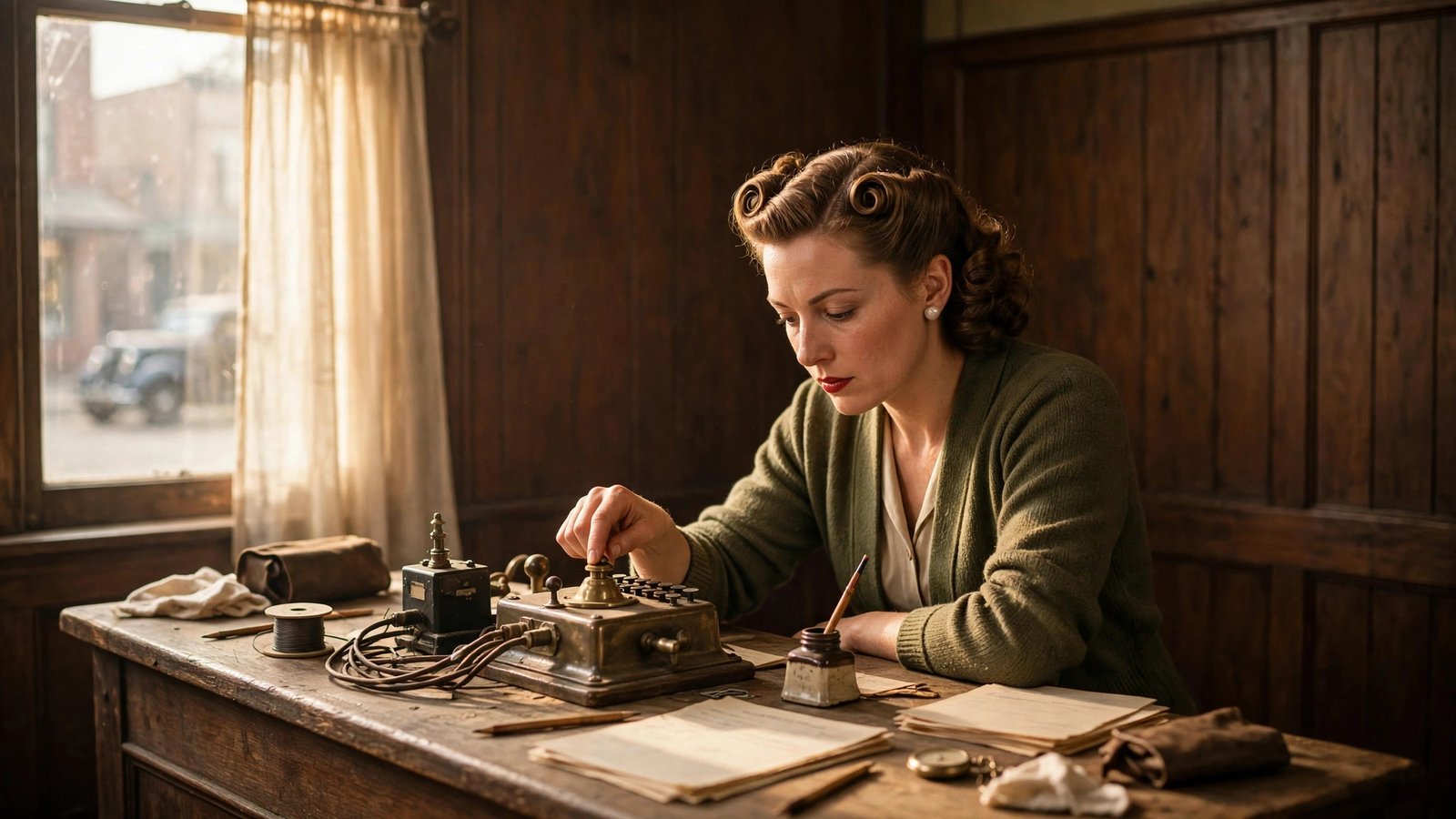
The Telegraph Office — What America Lost
Yellow paper. That's what you saw first, on the table by the door, and your stomach dropped before you read a single word. Good news and bad news came on the same yellow paper. You couldn't tell which until you picked it up.
You went to the telegraph office, usually a Western Union office on Main Street, and you wrote out your message on a form. The clerk counted the words, because you paid by the word, and you learned to say a lot with a few. There were no commas, no periods, no small talk. Every sentence ended with the word STOP, because punctuation cost extra.
The telegram was for the news that could not wait. A birth, a death, a wedding, a job, a train arriving at midnight. The yellow paper arrived at the door, and the person who opened it knew, before reading a single word, that something important had happened. Both kinds of news came the same way, on the same yellow paper, carried by a boy on a bicycle.
The telegraph had been carrying America's urgent news since the middle of the 1800s, and for more than a hundred years it was the fastest way to reach someone far away. A soldier's family waited for the telegram. A businessman sent one to close a deal. A mother sent one to say she was coming home.
Then the telephone got cheap, and the letter got faster, and the telegram became the slow way to say something urgent. The offices closed one by one, and Western Union sent its last telegram in 2006, after more than a century and a half.
Today a message crosses the world in a second, and it costs nothing, and we send a hundred of them a day. But none of them arrives on yellow paper, and none of them makes your heart stop when you see the boy on the bicycle. The telegram was slow, and it was expensive, and it was the most important piece of paper in the house.