
The TV Repairman — What America Lost
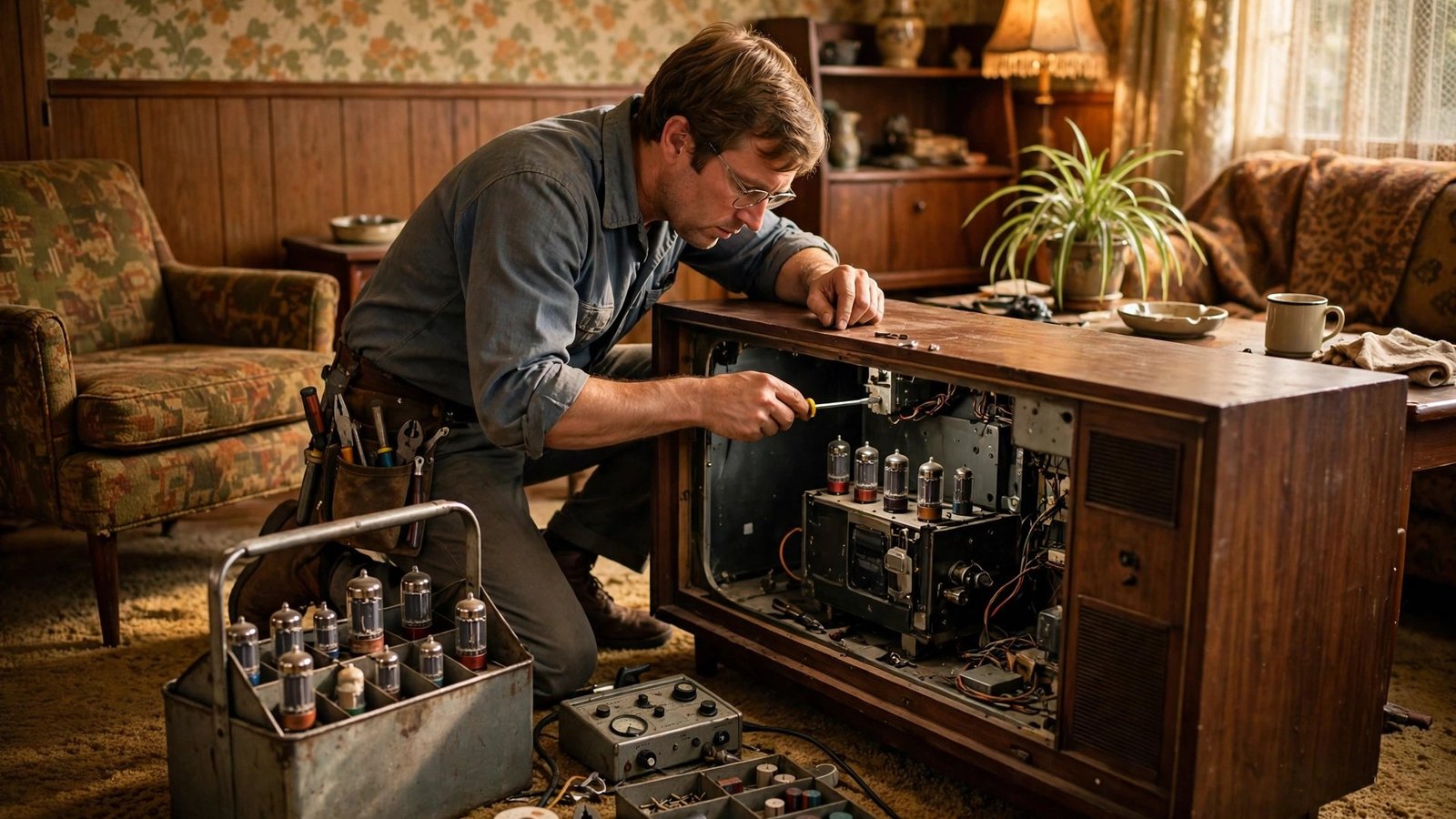
He took the back off the TV right there on our living room rug. Screws in a little pile, the case leaning against the couch, and him squinting inside like a doctor looking down a throat. “That one,” he'd say. “That's dead.”
When the television went on the blink, you did not throw it away. You called the repairman. He came to the house with a case full of tubes, and he took the back off the set right there in the living room. He knew the tubes by number, and he knew which one had gone bad just by looking at it, and he had a replacement in his case. He swapped it in, the picture came back, and the family gathered around the set again like nothing had happened.
The television of those days was a piece of furniture, big and heavy and expensive, and it was worth fixing. It had tubes inside it that glowed when it was on, and the tubes burned out, the way light bulbs burn out, and the repairman was the man who kept them burning. He carried a tube tester, and sometimes he took the bad tube down to the drugstore, where a machine on the counter would test it for free.
He was a regular visitor, like the milkman and the postman. He knew the house, and he knew the set, and he knew the family that watched it. He came on a Tuesday, or a Thursday, and he left the set working, and the children thanked him like he had performed a miracle.
Then the tubes gave way to transistors, and the transistors gave way to chips, and the television got cheaper and cheaper, until one day it cost less to buy a new one than to fix the old one. The repairmen closed their shops, one by one, and the case full of tubes went into the attic.
Today a broken television goes to the curb, and nobody calls anyone. The TV repairman was the man who kept the picture alive, and when he went, the television stopped being a piece of furniture you kept, and became a thing you replaced.